>> Eat the World NYC: Central Asia
Showing posts with label Central Asia. Show all posts

08 August 2020

Royal Garden Tbilisi

GEORGIA 🇬🇪

[COVID-19 UPDATE: Besides the couple tables in front, used mostly for coffee and lunch on the weekday of this visit, the restaurant has a covered outdoor space in the garden that can host quite a few people. Customers wishing for ample spacing and appropriate mask usage by staff and other customers might wish to avoid this place.]

On the few occasions that meals were taken at We Are Georgian, the previous tenant at this Kings Highway address, the small bakery and restaurant had always impressed. Last year, well before stay at home orders, a walk in the area had noticed that a new restaurant had unfortunately taken its place, but plans to give it a shot were made.


More than halfway through 2020, with outdoor dining in full bloom throughout the five boroughs, it seemed like the appropriate time to come back. Photos online showed a new backyard with plenty of seats and even a small stage for live music, which was all ready for action for a Friday evening that was fully booked a day in advance. No one was around for lunch though, the perfect time to sample the kitchen on short notice.

Even at lunch, and with a lack of customers, the music will be on in the garden as the soundtrack to everyone getting things set up for the busy night. Grab a table or a lounge-style seat and take a look through the menu. There are no descriptions for eaters less familiar with the names of Georgian foods, so either stick to what you know or start Googling.


One item that needs no introduction and is usually familiar to anyone that has eaten Georgian even just once is their dumpling. The khinkali (above) are listed as $2 per piece, but an order must contain at least six, so any dreams of ordering just one each as to be able to sample more dishes do not come to fruition. Regardless, performing such an abomination might get you thrown out of the place anyways.

Inside the thick wrapper, along with minced meats are just of hint of spiciness and a high level of herbs. It is delicious, although not juicy like most. The proper technique is to grab the thick top where the dough twists together and eat the rest, tossing the doughy stump to the side when finished. In Georgia, these piles of tops are almost like a record, as groups of men stack theirs and compete against each other while downing frosty mugs of beer.


When the khachapuri adjaruli ($14, above and below) arrived at the table, all eyes widened and there may have been just a bit of drool forming. The bread "boat" had puffed up and risen high above its cheesy interior, possibly setting a record in New York City for tallest khachapuri.

Take photos quickly and stir in the butter and egg before the cheese starts cooling. Once you have a good mix, start tearing off chunks of bread and dip them into the center to pull the cheese out. Served on a cutting board not even as long as the khachapuri, there is absolutely no way to keep this from getting messy, but it is worth it hands down.


Not appearing like much when it arrives at the table in a nondescript bowl, the megruli kharcho ($15, below) is actually a great order. Megruli is a descriptor for something from Samegrelo in western Georgia, which reaches both the coast of the Black Sea and up into the Caucasus Mountains. No matter what style of kharcho you are eating, there will be an abundance of walnuts pureed into the soup, and indeed the word "walnuts" is even added to the menu.

The soup is spicier than most things you will order at a Georgian restaurant, with a few flakes of roasted Turkish red pepper floating on the surface. Nuggets of dried beef are found beneath the surface, chewy like jerky and just right to suit the other tastes, which besides the tomato walnut puree include cherry plum paste for tartness, paprika, and fenugreek.


As always in Brooklyn, a 10% service charge will show up on your bill. No matter what the final price of the meal, there are leftovers and good value.

Kings Highway lost one good Georgian restaurant but gained another. Life moves on.

🇬🇪🇬🇪🇬🇪
GRAVESEND Brooklyn
230 Kings Highway

I COULD USE YOUR HELP
Eat the World NYC is and always has been free. No advertisements block the content or pop over what you read. If this website has helped you explore your city and its wonderful cultures a little better and you have the means to contribute, please consider doing so. Eat the World NYC is a labor of love, but also takes a lot of money and time everyday to keep running.

You can Venmo me @JAREDCOHEE or click here to send PayPal donation, no account is necessary. Thank you!

18 February 2020

Q.S. Palace

GEORGIA 🇬🇪

Depending on which side of Q.S. Palace you enter, you might end up with one of two first impressions that differ very greatly. On the right side, a simple food store makes half of the business, selling salads and breads and the full takeout menu from a counter.

Georgian crêpes and cheeses and sparkling waters can all be purchased quickly to take home. On this right side of the store, the window allows you to see inside and light escapes to the street. It is likely that this will seem like the entrance to the restaurant.

Georgian salad ($7.99)

But that is actually located behind the tinted windows of the left portion of the property. During daylight hours, opening this door will seem like entering a completely dark room at least until your eyes adjust. At night you can get some sense of the interior, but only coming inside lets you enjoy it fully.

The design and decor is that of a palace for sure, only condensed into a small New York City space. A pleasant blue is the preferred color of walls and ceiling, but it is the gold trim that pops out from crown moldings and other elements.


In Brooklyn, a meal at any former Soviet country's restaurant should usually begin with some cold appetizers like satsivi with chicken ($15, above) and eggplant with nuts ($10, below). These are easy to enjoy a few bites of amongst a group and get your taste buds ready for the main events.

The nuts in question, as usual when talking about Georgian food, are walnuts. On this dish called nigvziani badrijani, the delicious paste is spread over the rolled eggplant, and could only be made better by a more liberal application of pomegranate seeds.


Possibly the two most famous Georgian foods known to non-Georgians are both done very well here, starting with the Acharuli khachapuri ($12.99, above). Take your photos quick and mix up the egg and butter into the scalding hot cheese so everything cooks together.

While important to non-Georgians, khachapuri of course is indeed so Georgian that the tradition of making khachapuri now landed on the list of 48 items of intangible cultural heritage made by UNESCO. This type is sometimes called Adjarski, named for the Black Sea and Turkey-adjacent Autonomous Republic of Adjara in Georgia's southwestern corner where it comes from.


The second item that everyone knows is fresh khinkali ($12, above), Georgia's contribution to the world of dumplings. Khinkali appear like a hot water bag, but are thick-skinned soupy delights to be approached with caution.

Allow them to sit and cool for a bit, then turn sideways and bite a hole into the side. Suck out the fragrant herbal juices carefully and continue to the meat.

Dolma in vine leaf ($12)

Potato with mushrooms ($10)

Lamb chakapuli ($16)

If you have ever traveled in Georgia in the summer, one of the most memorable parts of the capital city of Tbilisi is the smells and sights of grilled meats. Vendors outside fill the air with a wonderful aroma of lamb, pork, and chicken on skewers, known locally as shashlik.

In Tbilisi you may find your meats served with Kakhetian bread, named after the far east region that features some of the best grilled meats as well. Here at Q. S. Palace they serve the lamb lula kebab ($11.99, below) inside of a flatbread that seems more Armenian style. This is packed with onions and pomegranate seeds, and can be dipped in their bright red sauce.


Ojakhuri ($12)

🇬🇪🇬🇪🇬🇪
BENSONHURST Brooklyn
Q.S. Palace Menu, Reviews, Photos, Location and Info - Zomato

I COULD USE YOUR HELP
Eat the World NYC is and always has been free. No advertisements block the content or pop over what you read. If this website has helped you explore your city and its wonderful cultures a little better and you have the means to contribute, please consider doing so. Eat the World NYC is a labor of love, but also takes a lot of money and time everyday to keep running.

You can Venmo me @JAREDCOHEE or click here to send PayPal donation, no account is necessary. Thank you!

13 August 2019

Nurlan Restaurant 诺兰饭店

EAST TURKESTAN 🏴󠁧󠁨󠁥󠁰󠁿🇨🇳

The food of Xinjiang Uygur Autonomous Region has always lived on the fringes of New York City, with sprinklings of its excitement here and there. Now closed Kebab Empire had a stall in the New World Mall of Flushing and a satellite branch in Hell's Kitchen called YANA, while the most notable and talked about restaurant is probably Brighton Beach's Kashkar Cafe. The problem with the latter, the new owner of Nurlan on Main Street in Flushing, is that the cuisine there is seen through the lens of Russians, who add far too much yogurt to many dishes and cook it not dissimilar to Uzbek cuisine.

This same type of outside focus can be true from the Chinese perspective as well, as in the new Jiang Diner in the East Village that replicates how the cuisine might be interpreted in Shanghai or Beijing. It even bills itself a "Northwestern Chinese" restaurant, completely erasing the identity of the Uyghurs (something of a habit for China), although this has not stopped local food writers to shamelessly fawn all over it.

At Nurlan, while still created with the neighborhood's Chinese population in mind, the owners describe themselves as "Central Asian style Turkic Uyghur food." Yogurt, it should be said, was only found in the form of a drink made from cow's milk in the fridge.


With all that being said, if you are familiar with Uzbek and other Central Asian cuisines, you will feel right at home here at Nurlan. Start off with samsa ($2 each, above), a racquetball-sized pastry filled with lamb and surrounded by slightly flaky yet moist dough. These pastries are a mainstay of any Central Asian kitchen and might come in different sizes and shapes depending on who is cooking them. Here while they might not make you scream in joy, they do the work and are satisfying.

A loaf of their Uyghur bread ($2, below) should always accompany the table during a meal, but do ask if it will be fresh as the one received on this day unfortunately lacked its normal crispness and seemed microwaved.


The Nurlan laghman ($12.99, below) is served in typical Uyghur style like a plate of spaghetti rather than in soup like its Uzbek and Dungan brethren. Like samsa, laghman is well known all over the region and cooked in many styles but all featuring meat, vegetables, and hand-pulled noodles. This version features wood ear mushrooms and a very slightly spicy and very tasty tomato sauce.

Despite being disappointed with the bread, the table continued to tear off pieces just to soak up each and every drop of the sauce once the noodles were eaten.


Even more exciting, and maybe making a debut in New York City is Ding-Ding laghman ($11.99, below) which features handmade extruded noodles that are cut into small pieces that resemble corn kernels before closer inspection. These are a pleasure to eat, but require putting the chopsticks down in favor of a spoon to scoop up equal portions of the oily noodles, meat, and peppers. Again the plate demanded to be mopped clean.


The restaurant has called in the talents of a nearby Xinjiang BBQ grill cart, which is now parked right in front of the door (see top photo). Any order of the lamb or chicken kebab ($2 each) from the main menu, or one of several from an addendum menu passed out in addition will see the griller get to work outside if he was not there already.

The three lamb kebabs seen below are just as good or better as the carts found up and down Main Street, and come dusted with a cumin-forward spice mix.


Listed on the menu as ravioli ($10, below), the bowl is what is better known as manti, small and delicate little dumplings served in a subtle meaty broth. While the first bite does not cause shock, the small nuggets are pleasingly addictive and on this occasion were gobbled up quite rapidly by three eaters.


Nurlan is clearly focused on its food. The humble space has about eight tables and not much else. The only splash of color comes from the psychedelic animal print tablecloths that seem to start moving by the time all the empty plates and bowls have been removed. Since this is an alcohol-free establishment, the food must have had a part in this. With a full stomach, it is clearly time to go and get started on planning that next visit with a larger group for dapangi ($20 or $30, not shown), also widely referred to as "big plate chicken" and one of the most famous dishes to originate in Xinjiang.

🏴󠁧󠁨󠁥󠁰󠁿🏴󠁧󠁨󠁥󠁰󠁿🏴󠁧󠁨󠁥󠁰󠁿🇨🇳🇨🇳🇨🇳
Nurlan Restaurant Menu, Reviews, Photos, Location and Info - Zomato

16 April 2019

Dolma Restaurant

AZERBAIJAN 🇦🇿

In a building that stands taller than most of its neighbors on Avenue X and sticks out just a bit, a few renditions of a fairly typical US American diner have come and gone over the past decade or so. Named after changing owners, first Pete, then Manny, and finally Elena, the restaurant has now did a complete 180 and its facade is decorated with some hints of what is happening in the kitchen these days.

The namesake of the new restaurant, opened at the beginning of February, refers to the stuffed grape leaves that are central in the cuisine of Azerbaijan. So special is the knowledge and skill of making these treats, and so important is the sharing of these techniques that UNESCO has included the tradition on their list of intangible cultural heritages.

Inside of the Gravesend restaurant, which sets a new bar for Azerbaijani cuisine in New York City, the walls are decorated cleanly with window frames and artwork showing scenes from the South Caucasus nation. Bright traditional fabric tablecloths adorn every table. The space is skinny, but the front can accommodate a few groups of 6-8 when necessary while the rear has some 4-tops. Our group of seven settled in very comfortably and was taken care of in spectacular fashion by our man Elmar, who made the night unforgettable. Since none of us were from Azerbaijan, he took it upon himself to show off his homeland in the best possible light and made sure every detail of our meal was perfect from start to finish.


The live music (two businesslike men playing a keyboard synthesizer and electric violin) was just getting started as our meal commenced with soups. Piti soup ($9, above) can be found in other Caucasus nations and Central Asia but perhaps is most popular in Azerbaijan. Is is hearty with cubes of fatty lamb mutton and vegetables, the broth rich from tail fat, dried sour plums, and maybe a sprinkle of saffron. Traditionally this is cooked and served in an earthenware pot.

Dovga soup ($7, below) is more specific to Azerbaijan and somewhat similar to Iranian ash-e doogh. Here it is a simple yet tasty dish served cold, consisting of yogurt and herbs, dominated by dill.


Make sure to get at least one basket of their tandir bread ($3, not shown), as many of the dishes will be crying to be mopped up with it like the soups above and the namesake dolma ($12, below). The juices that these grape leaves are served in turned out to be delicious and the table on this night did not let a drop of either pot we ordered go to waste.


The making and serving of dolma in Azerbaijan is typically saved for special occasions and "expresses solidarity, respect, and hospitality" according to UNESCO. Here they are filled with ground lamb, rice, onions, and spices, and none of us could get enough.

Another dish of small bites was the fried gurza ($11, below) tiny firm meat dumplings. The dish gets its name from a venomous snake found on the Absheron Peninsula where the capital Baku is located, but the filling is always lamb. The crispy exterior gives way to the luscious juicy interior, making popping these into your mouth a very satisfying experience, no dipping sauces required.


Although qutab ($2.50 each, above and below) is an Azerbaijani dish, you can also find versions at Tajik and other Central Asian and Persian restaurants. Essentially it is a thin, round piece of dough folded over either meat or vegetables and briefly fried in a pan. It was love at first bite when we first had this at Village Cafe on Coney Island Avenue.

The versions here were even better, as was most of the food. At Village Cafe and other Azerbaijani restaurants in Brooklyn, the cuisine seems to be seen through the prism of the Soviet Union, as can happen with a large Russian diaspora here in New York City. It happens with some Ukrainian restaurants and others as well. Dolma Restaurant excels in what seems to be more traditional foods cooked in the traditional manners of the country, with a menu that includes many items unseen on most menus here.


Not at all traditional was Beyonce, who spent the entire night on the television here as YouTube went through her entire catalogue. The volume was down of course since they had live musicians, but every once in a while their music and onscreen Bey would synch in a weird alternative world mashup.

In Azerbaijan it is popular to eat fish on a skewer, grilled fresh from lakes or the Caspian Sea. This is quite often sturgeon, also called beluga but not related to the whale, which seems to be the most eaten fish in the country. We tried the grilled sturgeon ($21, below) to celebrate this, which comes with a tart plum sauce that can be applied as desired. This is the fish caught primarily for the female's valuable eggs which when salt cured become caviar.


The group all seemed happy to experience jiz-biz ($15, below), a sauteed dish that always includes lamb heart, liver, and kidneys, but sometimes has extra ingredients depending on the chef like intestines. Since I had made the order confidently at the beginning, Elmar leaned down to me and whispered in my ear to let me know there were also testicles in this rendition. Convinced this group would not have any problems with this information, it was shared around and as expected everyone dove right in.


Besides the novelty, the dish was the only one of the meal that fell pretty flat as most of the cuts of meat were ultimately very dry and possibly overcooked.

Much better was the chigirtma ($12, below) a dish of on-the-bone chicken cooked in very hot oils and served in a tomato sauce with eggs. This is another dish that does not show up on the menus of Soviet-inspired places but should not be overlooked here. The name translates to "screaming," said to be the sound heard while it is cooked.


Sometimes chigirtma is served with plov, but we saved this course for the sabzi plov ($12, below), a dish that has a lot of Persian influence. "Sabzi" comes from Farsi meaning green and refers to the herbs used to create its unique taste, the boldest of which is garlic chives. This is a lamb dish and is served unlike most plov in that the meat and herbs are separate from the basmati rice. It is not gigantic, so for large groups more than one plate might be required so that everyone has more than just a small taste.


Sadj ($24, below) is the most expensive entree on the menu and gets served on a two-tiered contraption that can have a flame with charcoal underneath if necessary. This is actually where the dish gets its name, and examples in the country can span a range from utilitarian to highly decorative. In most houses, it is also used to do the actual cooking.

Along with tender chunks of lamb, there are mushrooms, red peppers, eggplants, zucchini, and a buttery bread similar to luchi or roti.


The gazan lula ($9, below) is a kebab served on two skewers that did not disappoint but maybe most memorable was the tomato-based sauce served alongside it. If you have ever eaten Central Asia kebabs, the sauce is never truly special, but this version enhances anything it touches.


End any meal with their excellent tea service ($10 for large pot, not shown), and a plate full of desserts. The intricately designed shakar bura ($3 each, below) won the night, with oohs and aahs from everyone at the table. These pastries (sometimes written shekerbura) are slightly sweet from sugar but rely on crushed almonds, walnuts, and hazelnuts in the delicious center.

Surprisingly as well, Dolma did not tack on a service charge like many restaurants in this part of Brooklyn like to, letting us round way up with a very good tip and not worry about where that 10% was going. We will back Elmar!

Shakar bura and mutaki.

🇦🇿🇦🇿🇦🇿
Dolma House Menu, Reviews, Photos, Location and Info - Zomato

17 March 2019

Sami's Kabab House

AFGHANISTAN 🇦🇫

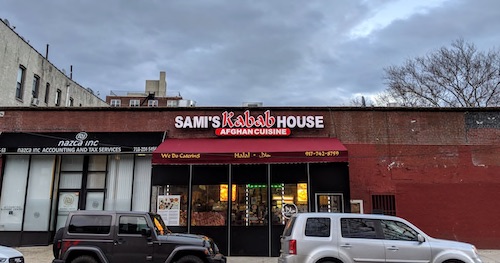
Sami's kind of lives in its own universe. Around the corner from busier 36th Avenue in Astoria, the spot is unassuming and the only glimpse of what all the fuss might be about is when waiting people are milling around outside the shop during busy nights. Inside, the dining room is much more formal and modern than other Afghan restaurants in town but still friendly and welcoming.

About one third of the space is taken by the kitchen, which runs from front to back along one wall, while the rest is dining tables. The wall opposite the kitchen is covered in beautiful imported fabrics that add a lot of warmth to the space if the smells from the kitchen were not already making you feel good.

A mixture of customers come here from Astoria and all over the city, drawn by rave reviews in important papers and online reviews. It makes itself very "user-friendly" for those unfamiliar with the cuisine, and makes a good entry point for anyone interested in learning more about the food and sampling their many kababs.


Before the large portions of meat, go for a plate of the lovely aushak ($5, above and below), vegetable dumplings filled with leeks and scallions. The thin wrappers would make Chinese grandmas proud, that is until the whole plate is drowned in a layer of their garlic mint yogurt sauce and then a lamb gravy.

They also have non-veg versions of this called mantu ($7, not shown), but I find meals here always get intensely meaty when the entrees arrive and think these aushak make for a more well-rounded meal.


My favorite of the chicken options is the Afghani kabab ($13.50, below), dark thigh meat that might be the most succulent piece of meat in the city. It is amazingly tender and juicy and tastes even better than it looks. They do breast as well and it is also surprisingly juicy, but the thigh is just better.


Most kababs and other entrees come with fragrant and wonderful basmati rice, but also make sure to upgrade your rice with qabuli for 50 cents, a sweet mixture of raisins and carrots that goes well with everything. This would also be a good time to explore the condiment dish that comes with four options in a tray like you see at noodle shops in Thailand. As I have said in previous Afghan meals, the availability of unlimited yogurt is a boon to my meal.

The other jars are filled with a red and green sauce, the latter of which is spicy, and some pickled peppers.


A plate of lamb sabzi chalao ($15.50, above) was also very tender, and is the same stew or gravy that was covering the dumplings. This is accompanied by a side of tasty spinach full of herbs and spices.

Salad arrives at the table with an entree purchase and usually a basket of Afghan naan does although not on this last visit. Both of these things are good for experimenting with the condiments as well. Also ask for a cup of the cardamom-infused Afghan green tea to accompany your meal.

Complimentary salad.

🇦🇫🇦🇫🇦🇫
Sami’s Kabab House Menu, Reviews, Photos, Location and Info - Zomato